Skip to content

Choosing the right solar street light is crucial for ensuring long-term stability, energy efficiency, and cost savings—especially in 2026, as solar technology advances and project requirements become more diverse. This guide takes you step by step from basic cognition to practical selection, helping you avoid common pitfalls.
Step 1: Clarify Your Core Needs (Determine the Foundation of Selection)
- Confirm the installation scenario: Urban roads, rural highways, communities, parks, or remote areas (different scenarios have different requirements for brightness and lighting time).
- Define key indicators: Required lighting area (sqm), lighting time (hours per night), and whether it needs to work normally on cloudy/rainy days.
- Clarify the budget range: Balance cost and performance to avoid overspending or choosing low-quality products.

Step 2: Master Key Technical Parameters
- Luminous flux (LM): The higher the value, the brighter the light (e.g., 3840LM for 30W, 6400LM for 50W).
- Battery capacity (mAh): Determines lighting time (high-capacity lithium batteries are recommended for long-term use, 30000mAh+ for 30W lights).
- Solar panel efficiency: Monocrystalline silicon panels (conversion efficiency >21%) are better than polycrystalline for low-light environments.
- Waterproof grade: IP67 is the minimum standard for outdoor use (resistant to heavy rain, dust, and harsh weather).


Step 3: Choose the Right Product Type (Split vs All-in-One)
- Split-type solar street lights: Separated solar panel, light fixture, and battery—flexible installation, easy maintenance, suitable for large-scale projects (e.g., NAISI LD-LZHL series).
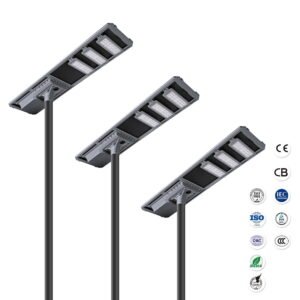
- All-in-one solar street lights: Integrated design, small size, easy installation—suitable for small scenarios (e.g., community paths, parks).


Step 4: Identify Reliable Suppliers (Guarantee After-Sales and Quality)
- Check factory strength: Whether there is a professional production line (e.g., NAISI’s Meizhou PV module factory) and strict quality control process.
- Confirm after-sales service: Whether there is a warranty period (usually 2-5 years) and timely technical support.
- Refer to project cases: Choose suppliers with successful cases in your target scenario (e.g., African rural road projects, urban community projects).


Step 5: Avoid Common Selection Mistakes
- Mistake 1: Blindly pursuing low price (ignoring battery and panel quality, leading to short service life).
- Mistake 2: Overlooking installation height (installation height 3-4M is suitable for most scenarios; too high/too low affects lighting effect).
- Mistake 3: Ignoring weather adaptability (choose products with high and low temperature resistance for extreme climates).